
Winter 2025 Newsletter

Download the PDF: Winter-2025_CTNA_Newsletter.pdf
From Seed to Strategy: Preparing the Nursery Sector for Canada’s Next Investment in Trees
Canada’s forests are at a turning point. Following recent changes to the federal Two Billion Trees program, many in our sector are understandably concerned about the future of large-scale reforestation. Yet amid uncertainty, our nursery community continues to grow hope.
Across the country, forest nurseries are preparing millions of seedlings for wildfire recovery, community planting, and climate adaptation. The capacity, expertise, and commitment are here. What’s needed now is renewed national leadership — one that recognizes reforestation not as a short-term project, but as a cornerstone of Canada’s climate resilience and biodiversity goals.
This moment is not an end but an inflection point. The Canadian Tree Nursery Association–Association canadienne des pépinières forestières (CTNA–ACPF) remains steadfast in working with governments, partners, and communities to ensure that Canada’s reforestation capacity is sustained, modernized, and ready for the next generation of planting.
Together, we can turn challenge into opportunity — from seed to strategy, from restoration to resilience.
- Rob Keen, RPF, Executive Director
2 Billion Tree Program Update
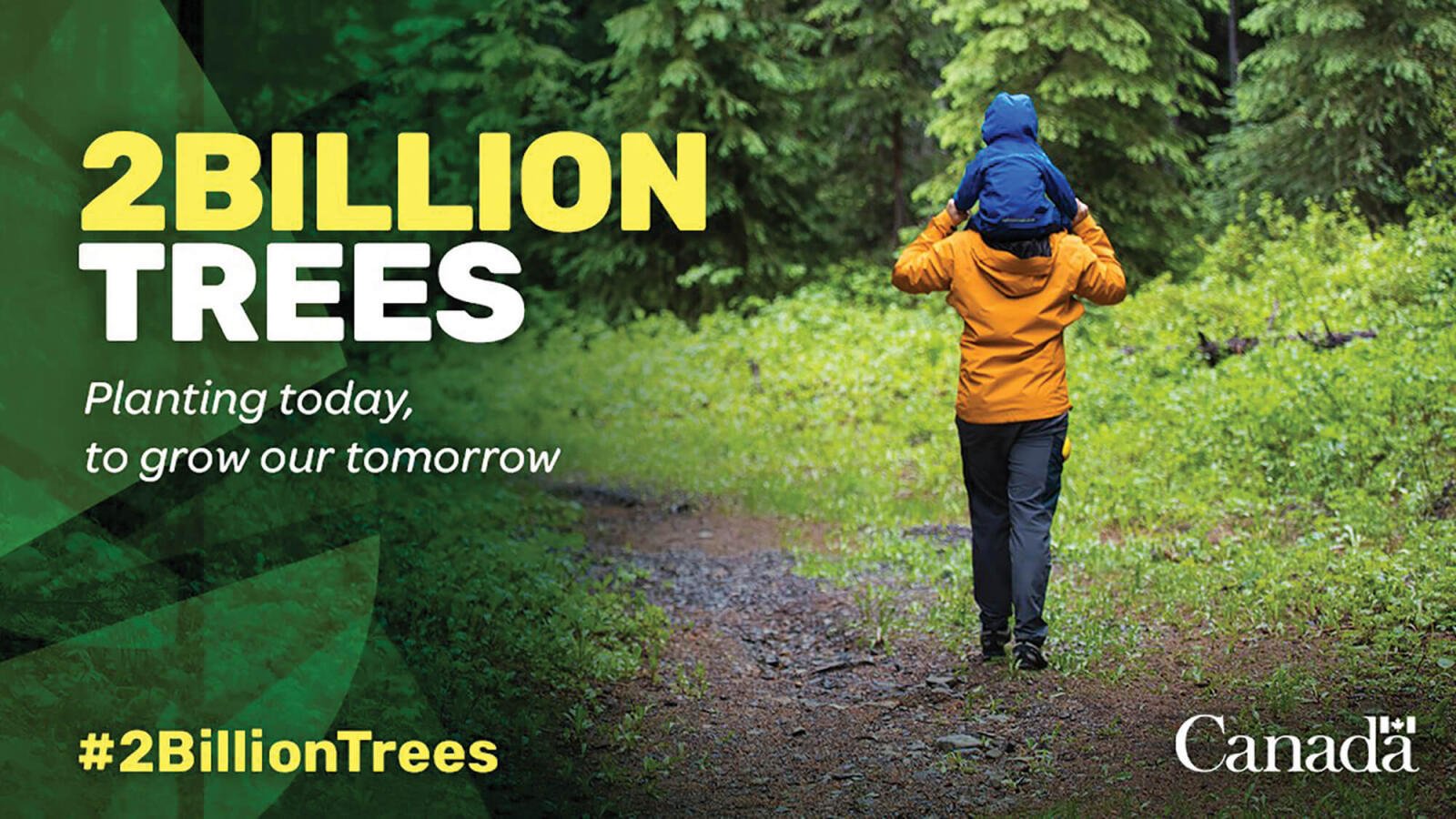
CTNA-ACPF is expressing deep concern over the federal government’s decision to cancel the remaining commitments of the Two Billion Trees (2BT) Program.
While the overall direction is ill-considered, commitments made until 2031 will be honoured. This is an important assurance given recent instability in federal program funding.
Rob Keen, RPF, Executive Director, CTNA-ACPF observed “This 2BT reversal undermines Canada’s environmental recovery and directly threatens the skilled workers, infrastructure, and long-term viability of our members and the forest restoration sectors.”
Canada is faced with an unprecedented restoration challenge. Since 2023, wildfires have consumed an estimated eight percent of forests in Canada, creating an ecological and economic crisis unlike any before. Restoring even 15 percent of the burned landscape would require more than 7.3 billion seedlings—a scale far beyond the reach of the original 2BT program. This level of restoration is only possible by supporting the services our members provide.
Beyond its environmental value, large-scale reforestation represents a powerful economic driver. A coordinated effort to restore fire-damaged forests could generate over 31,000 full-time jobs and stimulate sustainable growth across rural communities, proving that forest recovery is both an ecological necessity and an economic opportunity.
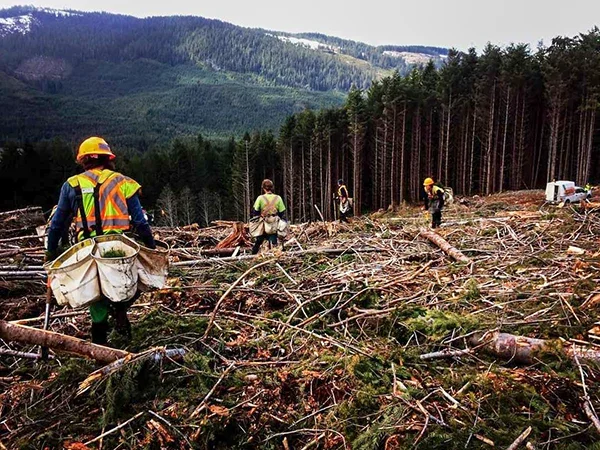
Rather than cancelling these essential investments, CTNA-ACPF continues to urge federal government decision-makers to support a National Post-Wildfire Forest Restoration Program. CTNA-ACPF invites federal and provincial governments to assess strategic mechanisms including the Major Projects Office (MPO) and the Canada Growth Fund (CGF) that could provide stable, long-term financial support for national forest recovery.
This approach would evolve post wildfire forest recovery from a short-term effort to a national priority, ensuring:
National Coordination and Accountability: Establishing clear oversight for a massive, multi-year undertaking.
Predictable, Multi-Year Funding: Offering the stability required to allow the restoration sector to invest in expansion and support local, rural economies.
Targeted Restoration: Ensure the right trees are planted where natural regeneration is failing, optimizing ecological recovery.
Alignment with National Goals: Integrating post-wildfire forest recovery with Canada’s broader climate, biodiversity, Indigenous partnership, and rural employment targets.
Every Canadian who has witnessed the three years of record-breaking wildfires understands the urgent need for a focused, strategic, and long-term program. Investing in forest recovery, is crucial to the future of our forests, climate goals, and the economic wellbeing of the communities that depend on them.
Read our recent article here: Federal Tree Planting Deserves Major Project Status Not Cuts
Wildfire Recovery & Seedling Demand Update
This past August, during CTNA–ACPF’s Second Annual General Meeting held at the Forest Genetics Conference in Ottawa, new data was presented confirming the rapid increase of Canada’s reforestation challenge following three consecutive record-breaking wildfire seasons.
It was reported that more than 6.8 billion seedlings would be required to restore just 15% of forests lost to the 2023, 2024, and early 2025 wildfires. Since that release, updated burn-area figures now place the requirement closer to 7.3 billion seedlings as of November.
These findings illustrate how back-to-back wildfire years have pushed Canada’s forest-restoration system to a critical tipping point.
“The scale of destruction is taking a tragic toll on Canadian communities and our forests,” said Rob Keen, Executive Director of CTNA–ACPF. “This is not just an environmental crisis—the economic and social costs require immediate action from our Prime Minister, Premiers, and Forest Ministers.”
Report Highlights
British Columbia’s annual planting is projected to decline from 300 million (2024) to 226 million (2026)—a 74 million-seedling shortfall.
Saskatchewan’s production forests have been severely affected, threatening long-term wood supply and economic stability.
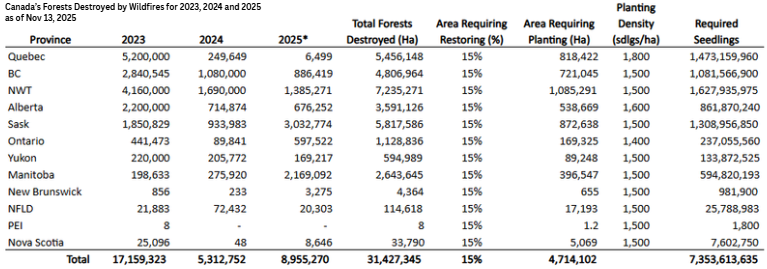
CTNA–ACPF’s analysis calls for immediate government action to strengthen Canada’s forest restoration economy by:
Committing long-term to restoring Crown forests and providing predictable planting demand.
Integrating western science and traditional knowledge to ensure “the right trees in the right place.”
Addressing labour shortages through targeted training via the Forest Nursery Training Program (FNTP).
Acting now. Since growing the required seedlings takes 2–4 years of advance work, including seed collection, nursery growing cycles, and planting coordination.
Translated into practical terms, to restore just 15% of the area burned, this would mean expanding capacity by roughly 300 million additional seedlings per year over the next 25 years—an achievable and phased target if supported by stable, long-term policy leadership.
“Strategic, long-term planning in this sector has a profound impact on the health of our forests, the resilience of our communities, and Canada’s economy,” emphasized Mike Downing, CTNA–ACPF Chair.
CTNA–ACPF continues to urge federal and provincial leaders to treat Canada’s forest-restoration sector as essential national infrastructure—a system that includes seed collectors, nurseries, tree planters, and restoration specialists. At its core is Canada’s nursery network, which produces more than 95% of the nation’s reforestation seedlings, which forms the foundation on which all restoration work depends.
Read the full article here: Wildfire Restoration Seedling Demand 2023-2025
Economic Analysis of Canada’s Forest Restoration Sector
Earlier this year, CTNA–ACPF released the first-ever national economic analysis of Canada’s tree seedling sector, confirming what many in the industry already knew — that forest nurseries are foundational to Canada’s climate goals, rural employment, and long-term forest health.
Now, CTNA–ACPF is building on that foundation by working to expand the analysis to capture the full scope of Canada’s forest restoration economy, including seed collection and processing, nursery production, site preparation, planting operations, and post-planting monitoring.
This next phase of work will quantify the total economic, environmental, and employment value generated by the entire restoration supply chain, from seed to seedling to forest — highlighting the amplified impact of coordinated public investment.
To advance this initiative, CTNA–ACPF is collaborating with Natural Resources Canada (NRCan) and the Forest Gene Conservation Association (FGCA) on data and methodology related to the price of seed collection and management systems.
“By understanding the economics of every link in the restoration chain, we can demonstrate that investing in forest restoration isn’t just an environmental commitment — it’s a national economic strategy,” said Rob Keen, Executive Director of CTNA-ACPF.
This expanded analysis will serve as a key advocacy and planning tool for policymakers and partners ahead of the next federal budget, helping ensure that Canada’s forest restoration economy receives the recognition and investment it deserves.
Read the previous full report here: Economic value of Canada’s tree nursery sector
AGM Recap
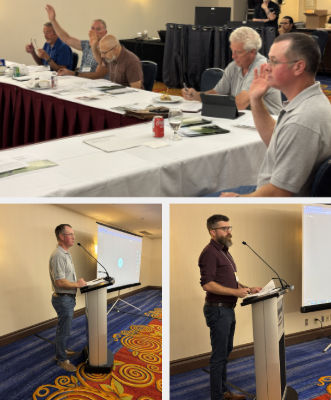
Mike Downing, President & Brent Forbes, Treasurer of CTNA-ACPF
CTNA-ACPF held its Second Annual General Meeting (AGM) in August during the Forest Genetics 2025 conference in Ottawa.
We were thrilled to reconnect with members, partners, and colleagues from across the country. The AGM was an opportunity to review progress over the past year, highlight milestones—including the completion of the FNTP Business Plan—and outline next steps for 2026.
A sincere thank-you to everyone who attended and contributed to the discussions. Your participation continues to shape CTNA-ACPF’s direction and strengthen our collective efforts to grow Canada’s forest-restoration capacity.
Conference Highlights
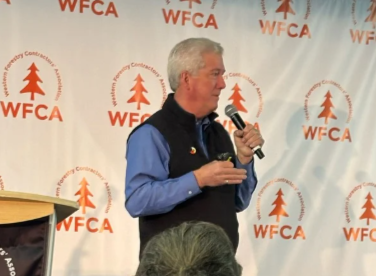
Rob Keen presenting CTNA-ACPF updates at the WFCA Conference
Throughout 2025, CTNA–ACPF has been proud to participate in key forestry and nursery sector gatherings across the country, connecting with partners, members, and restoration leaders from coast to coast. This year, CTNA-ACPF attended and contributed to:
Western Forest Contractors Association Conference – Victoria, BC
Office des producteurs de plants forestiers du Québec (OPPFQ) Forest Nursery Conference – Québec City, QC
BC First Nations Forestry and Youth Conference – Penticton, BC
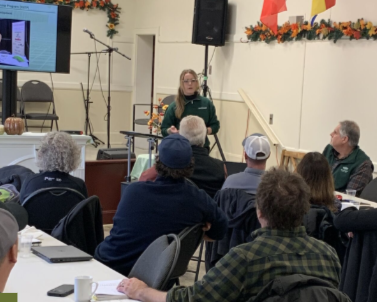
Kaylen Foley presenting updates on the FNTP at the Atlantic Nursery Meeting
Forest Genetics 2025 / CFGA–FGCA Conference – Ottawa, ON
Forest Nursery Association of BC (FNABC) Annual Conference – Sidney, BC
Forest Products Association of Canada – National Policy Conference 2025 in Ottawa, ON
Atlantic Nursery Meeting – Juniper, NB
CTNA–ACPF presented at most of these events, providing updates on national initiatives including the Forest Nursery Training Program (FNTP), the Wildfire Restoration and Seedling Demand Report, and the ongoing advocacy for long-term investment in Canada’s forest restoration economy.
The Atlantic Nursery Meeting held special significance—it was the very event where CTNA–ACPF was first launched in 2023. Returning two years later to share our progress with members, partners, and provincial representatives was an important milestone and a reminder of how far we have come in building a unified national voice for Canada’s nursery sector.
Each of these conferences strengthened relationships with restoration partners and reinforced CTNA-ACPF’s leadership in advancing coordinated, science-based, and workforce-supported reforestation across Canada.
Policy & Partnerships
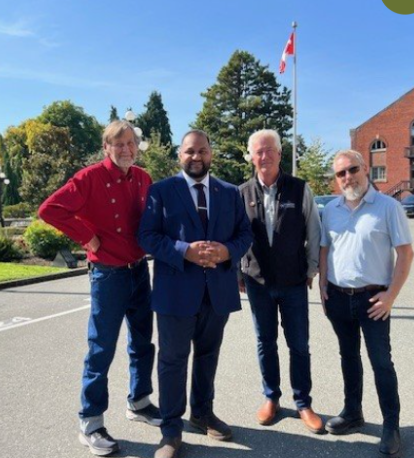
Minister Paramar, Rob Keen, and Steven Kiiskila from Arbutus Grove Nursery Ltd
CTNA–ACPF continues to engage actively with governments and partners to advance coordinated, long-term forest restoration planning across Canada.
Earlier this year, letters were sent to all provincial forestry jurisdictions outlining CTNA-ACPF’s priorities for post-wildfire recovery and long-term seedling supply stability.
These letters introduced CTNA-ACPF’s Four-Point National Plan for Post-Wildfire Restoration, which calls for:
Identifying priority reforestation areas to guide targeted restoration efforts.
Coordinating the restoration supply chain — including assessments, seed collection, nursery production, planting, and monitoring.
Integrating science and Indigenous knowledge to ensure the right trees are planted in the right places for climate resilience.
Fostering collaboration among Indigenous communities, governments, stakeholders, and industry to achieve shared restoration goals.
Nearly all provinces have since responded, with follow-up meetings underway or scheduled to explore how CTNA-ACPF’s recommendations can align with provincial priorities and the upcoming federal budget.
Forest Nursery Training Program
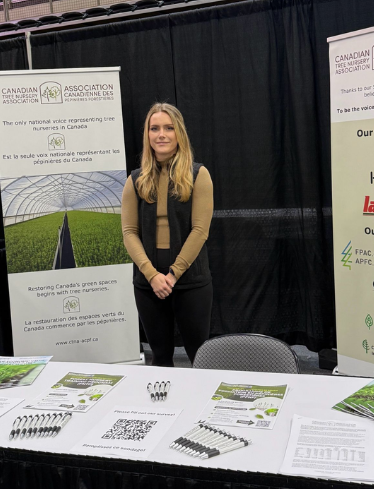
With funding assistance from the federal government’s 2 Billion Tree Program, CTNA-ACPF has launched an important project to address the growing demand for skilled nursery workers in Canada. This initiative will play a key role in equipping the next generation of workers for the critical tasks of seedling production and forest restoration.
The main goals of this project include:
Understand Training Needs: Generate a detailed understanding of the core training requirements needed to meet the current and future needs of the nursery sector.
Develop Curriculum & Training Programs: Design a comprehensive training structure that will effectively recruit and train both new and existing nursery workers to meet these demands.
Thanks to the help of the Task Team, we’re excited to announce the completion of the FNTP Business Plan, a major milestone toward a national training program for Canada’s nursery workforce.
Next steps include finalizing curriculum design, establishing co-op partnerships, and identifying host nurseries for the first pilot offering targeted for Fall 2025.
This fall, our Director of Operations, Kaylen represented CTNA-ACPF at several career fairs in New Brunswick, including the University of New Brunswick. These efforts are part of our broader national outreach to raise awareness of the FNTP and the diverse career opportunities within the nursery sector. Through school, college, and career-fair presentations across Canada, we are helping students and job seekers discover meaningful, long-term roles in seedling production, greenhouse management, and restoration operations.
Interested in hosting a student?
If you are interested in hiring students or recent graduates, please email your job ads to kfoley@ctna-acpf.ca and fill out the survey below.
Fill out our survey by clicking the link here
National Survey on Pest & Disease Management
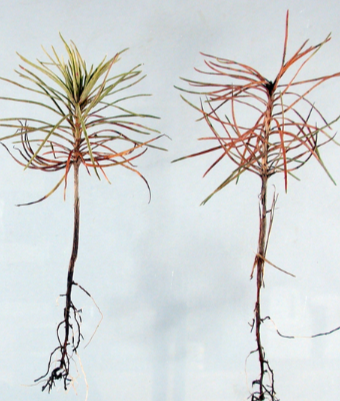
Canada’s forest nurseries are increasingly challenged by pest, disease, and weed pressures at a time when access to effective management tools is becoming more limited. As the Pest Management Regulatory Agency (PMRA) reviews and phases out older products, newer alternatives are often approved first for major agricultural crops. Forestry and nursery uses, however, frequently do not receive timely label expansions, which creates gaps in available controls and impacts seedling health and operational success.
Members from British Columbia, Québec, and Ontario have raised concerns about the shrinking range of effective options for managing key pests and diseases. In response, CTNA–ACPF is initiating a national effort to better understand these challenges and ensure the sector is represented in federal minor-use priority discussions.
A coordinated, evidence-based approach will give our sector a stronger, united voice in national regulatory and research discussions.
This will allow us to:
Identify the most pressing pest, disease, and weed issues across Canadian nurseries
Understand where no or insufficiently effective control options exist
Strengthen the sector’s voice in national regulatory and research processes
Help inform future efficacy trials, label expansion requests, and long-term solutions
CTNA–ACPF’s next steps includes working with the Forest Nursery Association of BC, along with industry experts to determine the most effective way to move this initiative forward. Our immediate next step is developing a National Nursery Pest & Disease Survey to gather input from producers across Canada and establish clear national and regional priorities.
We are also exploring opportunities to participate in the federal minor-use priority-setting process and identifying potential funding sources—through provincial minor-use programs, Agriculture and Agri-Food Canada, manufacturers, and other partners—to support future efficacy trials and data generation.
This work will help build the evidence base needed for more timely access to effective pest-management tools, strengthen coordination across provinces, and support long-term solutions for healthy, resilient seedling production nationwide.
Membership Spotlight
Across the country, nurseries are leading the way in forest restoration and testing new approaches, training the next generation, and delivering the seedlings that make reforestation possible. Our Membership Spotlight section is dedicated to sharing these stories. Whether you're trialing new techniques, expanding your operations, or welcoming new staff, your work deserves to be recognized and celebrated by the national nursery community.
We invite all members to contribute to future editions of the newsletter. Have a project update, innovation, or seasonal success to share? We’d love to hear from you. Your insights not only inspire others, they help strengthen our collective voice.
Please email any updates, stories, or successes to kfoley@ctna-acpf.ca to be featured in the next newsletter.
Somerville Seedlings Inc.
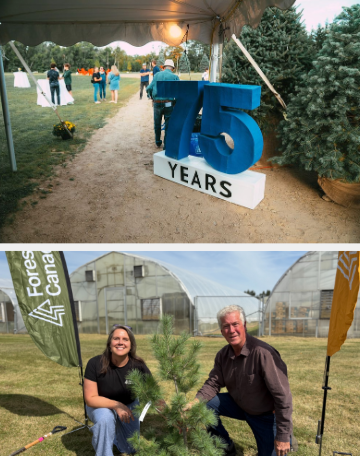
Jess Kaknevicius, CEO of Forests Canada and Rob Keen celebrating the 50 million tree milestone
Somerville Nurseries Inc. celebrated their 75th year of business in September with a great event at their farm in Everett, ON. Beginning in 1950, planting Christmas trees around Simcoe County, they have grown into one of the largest Christmas Tree wholesalers in Canada and the largest bareroot seedling grower in the province.
This year also marked a significant accomplishment for Forests Canada with the planting of 50 million trees since 2004. Somerville Seedlings Inc has been proud to be the largest supplier to this program, growing nearly 23 million seedlings for planting sites across Ontario.
Arbor Nursery Ltd
On June 26, 2025, in recognition and celebration of the 150th Anniversary of the Prince Edward Island Regiment, Arbor Nursery generously provided a maple tree to be officially planted on the grounds of Government House by the Regiment’s Colonel-in- Chief, His Royal Highness The Prince Edward, Duke of Edinburgh.
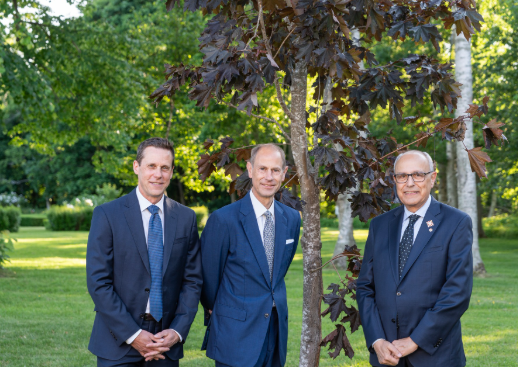
Honourable Rob Lantz, Premier; His Royal, Highness The Duke of Edinburgh and Honourable Wassim Salamoun, Lieutenant Governor
Landing Nursery Ltd
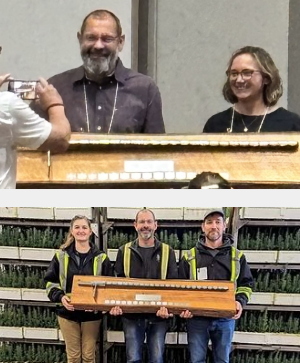
Landing Nursery Ltd, including Josh Enns staff holding the Chief Forester’s Award
Congratulations to Josh Enns and the staff of Landing Nursery Ltd for being awarded the Forest Nursery Association of BC 2025 Chief Forester’s Award.
The Chief Forester’s Award is presented annually to the nursery that succeeds in producing the best specification seedlings of a BC forest species and stock type chosen by the AGM Organizing Committee. This marks the second consecutive year that Landing Nursery Ltd has received this recognition, a testament to their continued commitment to growing high-quality seedlings that contribute to the health and resilience of British Columbia’s forests.
We applaud their leadership and dedication to excellence in forest seedling production.
CTNA-ACPF Updates
CTNA Swag Now Available for Members!

You asked — we listened! CTNA–ACPF is excited to announce that Association-branded swag is now available for members to order.
This initiative came directly from member requests at recent events and meetings, and we’re thrilled to help showcase our growing community with professional, high-quality CTNA-ACPF gear.
All items are offered at cost with free shipping anywhere in Canada.
To keep things simple, e-transfers will be collected before we place the group order.
Place your order by clicking the link here
Once we receive your order, we’ll confirm your total and shipping details, then send your items as soon as they’re ready.
Thank you for helping represent the Association and Canada’s nursery community!
CTNA Moving to Bi-Monthly Newsletters
We’re excited to share that, starting January 2026, CTNA–ACPF will be transitioning from quarterly to bi-monthly newsletters.
This change comes in response to member feedback asking for more frequent updates on Association activities, funding opportunities, research highlights, and upcoming events.
Our goal is to help members stay connected and informed year-round as we continue building momentum in Canada’s forest restoration economy. Stay tuned for the first bi-monthly edition in January 2026
Thank you to our partners and sponsors
We want to express our sincere gratitude to our partners and sponsors for their invaluable support. Your dedication and contributions make our work possible, helping us drive meaningful progress in forest restoration and ecosystem health across Canada.
Together, we’re building a greener, more sustainable future. Thank you for being an essential part of this journey!
Sponsors

Partners



Canadian Tree Nursery Association-Association Canadienne des Pépinières Forestières
719 Skyhills Rd
Huntsville, ON
P1H 2N5