
7.3+ Billion Tree Seedlings Needed to Restore Just 15% of Forests Burned by Wildfire (2023–2025
Download the PDF: CTNA ACPF Release Jan 30_2026_Final
Over 7.3B seedlings needed to restore just 15% of forests destroyed in 2025, 2024 & 2023 wildfires - Canadian Tree Nursery Association-Association Canadienne des Pépinières Forestières (CTNA-ACPF) calls for immediate government action.
(Victoria, BC, January 30, 2026) New data reveals a staggering gap in Canada’s post-wildfire forest restoration efforts. Current programs are restoring only a small fraction of forests lost to recent wildfires. The Canadian Tree Nursery Association–Association Canadienne des Pépinières Forestières (CTNA-ACPF) today issued a call for immediate and substantive action from provincial and federal governments to dramatically increase commitments to restoring wildfire-impacted forests.
Speaking at the Western Forest Contractors Association (WFCA) Annual General Meeting and Conference, Rob Keen, RPF, Executive Director of the CTNA-ACPF, warned that more than 7.3 billion seedlings are required to restore just 15% of the forests destroyed by wildfires between 2023 and 2025—more than 10 times Canada’s current annual seedling production capacity.
Seedlings Required to Restore Just 15% of Canada’s Forests Destroyed in 2023, 2024 & as of August 2025 Wildfires
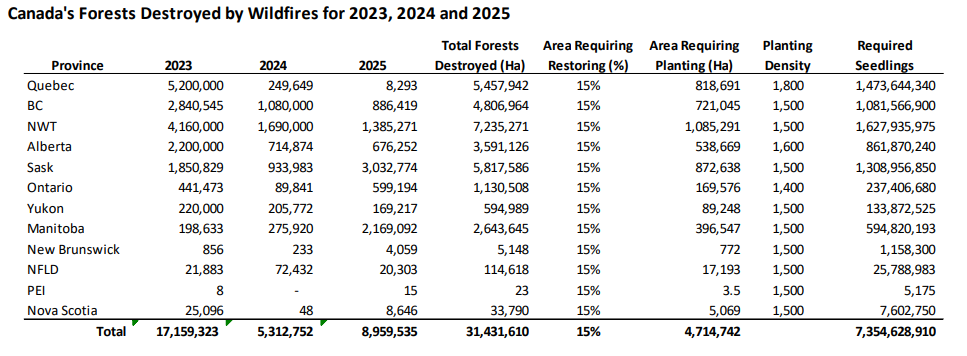
(Note: These numbers are conservative and assume 15% of burned areas will be replanted at a density of 1,500- 1,800 seedlings per ha. as per standards in each jurisdiction. This planting is separate and distinct from the legal responsibility of the forest industry to replant post-harvest.)
“The crisis is compounded by a troubling biological trend—the declining ability of forests to regenerate naturally after more frequent and higher-intensity wildfires,” said Keen. “We are seeing a significant reduction in natural regeneration following these fires. Without a massive, coordinated planting effort, we risk losing public assets, biodiversity, and the carbon sequestration benefits these forests provide for generations.”
A Sector at a Crossroads
Despite rapidly escalating need, restoration efforts are being undermined by funding instability and declining production capacity. In British Columbia, seedling production is projected to fall from 300 million in 2024 to 226 million by 2026. Quebec’s annual planting is projected to decrease from 143 million seedlings in 2023 to 125 million by 2026. In Saskatchewan, recent fires have devastated production forests, yet no proactive restoration measures are currently in place. At the federal level, the Two Billion Trees Program, which previously supported restoration initiatives, has been dismantled.
“Planning and growing the right tree for the right site takes two to four years,” Keen explained. “Our sector depends on long-term, predictable commitments to sustain infrastructure and retain a skilled workforce. A multi-year biological process cannot be managed through stop-and-go funding cycles.”
The CTNA-ACPF Path Forward
To address this national emergency, the CTNA-ACPF is calling for the creation of a National Post-Wildfire Forest Restoration Program with the following objectives:
Establish a National Forest Restoration Task Team bringing together regional, provincial, First Nation, and federal experts to coordinate a practical and regionally responsive recovery effort.
Bridge the growing natural regeneration gap by applying the latest forest restoration science to identify areas where natural recovery is no longer viable.
Rapidly identify priority reforestation areas to improve long-term climate resilience.
Coordinate restoration logistics, including damage assessments, seed collection, nursery production, planting, and monitoring.
Foster Indigenous partnerships that integrate traditional knowledge with western science to strengthen forest resilience.
Grant “Major Project” status to large-scale reforestation initiatives through the Major Projects Office or other federal programs to ensure long-term stability and economic growth.
“Our nurseries are vital employers in rural Canada,” added Keen. “Strategic investment in forest restoration will not only protect climate goals but also generate thousands of jobs and support the long-term viability of the forest sector. Tree planting is not a discretionary program—it is a nation-building investment.”
The CTNA-ACPF is calling on the Prime Minister, Premiers, and Ministers responsible for forests to act now to secure the future of Canada’s Crown forests.
–30–
Media Contacts
On-site in Victoria: Rob Keen, RPF, Executive Director, CTNA-ACPF, Cell: (416) 706-3230, Email: rkeen@ctna-acpf.ca
To schedule English or French interviews: Don Huff, Cell: (416) 805-7720, Email: dhuff@ctna-acpf.ca
Additional information about the Canadian Tree Nursery Association-Association Canadienne des Pépinières Forestières (www.ctna-acpf.ca)
The Canadian Tree Nursery Association-Association Canadienne des Pépinières Forestières (CTNA-ACPF) advocates on behalf of 64 tree nurseries (CTNA-ACPF Membership) from coast to coast to coast. Formed in 2023, the CTNA-ACPF is the only national voice representing tree nurseries in Canada. Our members grow more than 95% of the nation’s forest restoration tree seedlings.
Directors: Ryan Scott, Scott and Steward Forestry Consultants Ltd. Mike Downing, L’office des producteurs de plants forestiers du Québec (OPPFQ), Brent Forbes, Somerville Nurseries Inc., Scott Formaniuk, Coast to Coast Reforestation Inc. Renee Yardley, CCO, PRT Growing Services Ltd.
Sponsors: Harnois Greenhouses - Lumineux de nature | Brighter by design, Lambert Peat Moss